 Image 1 of 1
What if stronger instruction begins before the lesson is ever taught?
Teachers are expected to unpack standards, navigate curriculum resources, design rigorous instruction, differentiate for diverse learners, assess understanding, and respond to student needs, often while moving quickly from one lesson to the next. In the process, lesson planning can become focused on what students will do rather than on the deeper thinking required to understand what students need to learn.
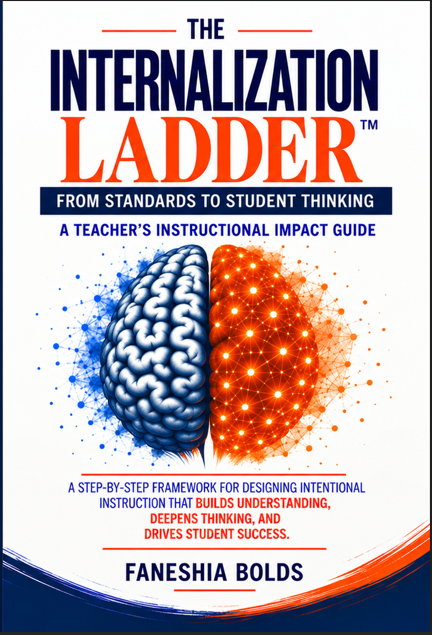
The Internalization Ladder™ offers a practical framework for slowing down that thinking without adding another complicated planning process.
This book helps educators move beyond simply preparing lessons to deeply internalizing the learning. Through a clear, intentional process, teachers learn to examine standards, identify the knowledge and skills students need, consider cognitive demand, establish learning targets and success criteria, anticipate misconceptions, plan explicit instruction and scaffolds, determine evidence of learning, and respond to what students reveal during instruction.
But internalization does not end when the lesson begins.
Teachers teach. They notice. They respond. They reflect. They refine.
The Internalization Ladder™ recognizes that effective instruction is a continuous cycle of teacher thinking before, during, and after the lesson. When teachers understand the learning deeply, they are better positioned to teach with clarity, recognize what students understand, and make intentional decisions about what comes next.
Designed for classroom teachers, instructional coaches, school leaders, and anyone responsible for strengthening Tier 1 instruction, this book provides a practical way to support the complex instructional decisions educators make every day.
The goal is not a perfect lesson plan.
The goal is a teacher who understands the learning deeply enough to make purposeful decisions and students who are increasingly able to do the thinking for themselves.
It is time to move beyond planning the lesson.
It is time to internalize the learning.
Let’s climb.
What if stronger instruction begins before the lesson is ever taught?
Teachers are expected to unpack standards, navigate curriculum resources, design rigorous instruction, differentiate for diverse learners, assess understanding, and respond to student needs, often while moving quickly from one lesson to the next. In the process, lesson planning can become focused on what students will do rather than on the deeper thinking required to understand what students need to learn.
The Internalization Ladder™ offers a practical framework for slowing down that thinking without adding another complicated planning process.
This book helps educators move beyond simply preparing lessons to deeply internalizing the learning. Through a clear, intentional process, teachers learn to examine standards, identify the knowledge and skills students need, consider cognitive demand, establish learning targets and success criteria, anticipate misconceptions, plan explicit instruction and scaffolds, determine evidence of learning, and respond to what students reveal during instruction.
But internalization does not end when the lesson begins.
Teachers teach. They notice. They respond. They reflect. They refine.
The Internalization Ladder™ recognizes that effective instruction is a continuous cycle of teacher thinking before, during, and after the lesson. When teachers understand the learning deeply, they are better positioned to teach with clarity, recognize what students understand, and make intentional decisions about what comes next.
Designed for classroom teachers, instructional coaches, school leaders, and anyone responsible for strengthening Tier 1 instruction, this book provides a practical way to support the complex instructional decisions educators make every day.
The goal is not a perfect lesson plan.
The goal is a teacher who understands the learning deeply enough to make purposeful decisions and students who are increasingly able to do the thinking for themselves.
It is time to move beyond planning the lesson.
It is time to internalize the learning.
Let’s climb.